In Indian homes, festivals and family milestones are measured by the aroma of roasting ghee, crushed cardamom, and bubbling sugar syrup drifting from the kitchen. While store-bought sweets are convenient, commercial mithai often relies on adulterated khoya, refined palm oil, and excessive sugar to extend shelf life.
Preparing traditional sweets and festive prasad at home gives you complete control over the purity of your ingredients. More importantly, once you understand how heat control and vessel thickness affect milk solids, dough fermentation, and frying temperatures, these classic dishes become surprisingly easy to recreate.
Here are five iconic regional sweets and festive recipes, along with the culinary techniques that guarantee perfect results every single time.
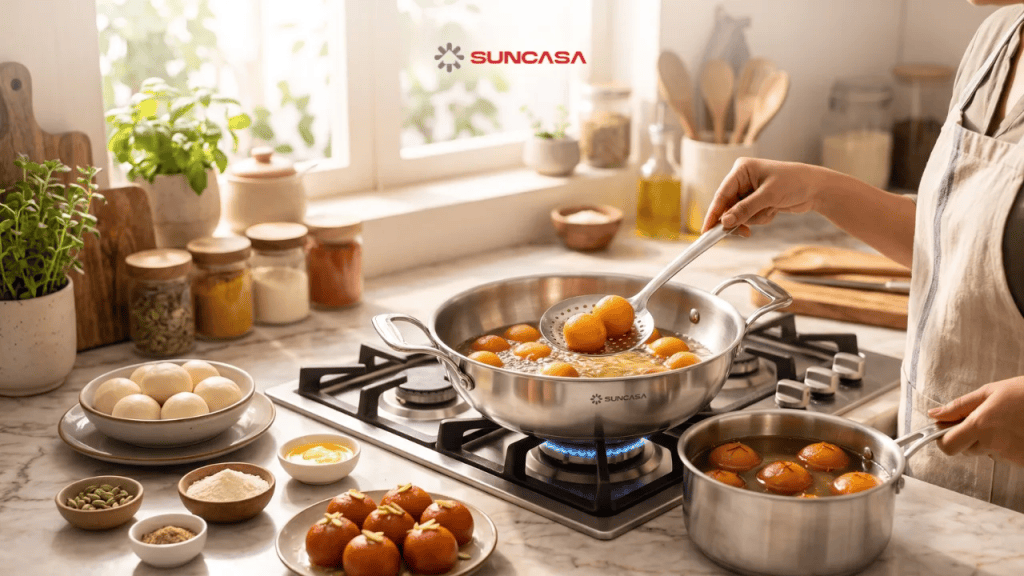
1. Melt-in-the-Mouth Homemade Gulab Jamun
Few desserts command as much universal love across India as warm, syrup-soaked Gulab Jamun. Yet many home cooks struggle with dumplings that either crack open in the oil, turn hard at the centre, or refuse to absorb the sugar syrup.
The secret lies in moisture balance and gentle kneading. Start with fresh, soft khoya (mawa) grated finely so there are no lumps, and blend it with a small proportion of all-purpose flour (maida) and a pinch of baking powder.
Instead of kneading the mixture aggressively like bread dough, gently bring it together with your fingertips using a splash of warm milk until it forms a smooth, crack-free ball. Roll the portioned dough between grease-coated palms until completely seamless.
Temperature stability during frying is what separates a dense ball from a pillowy sponge. Following a tried-and-tested homemade gulab jamun guide in a heavy-bottomed triply kadai ensures the oil stays at a gentle medium-low heat, allowing the dumplings to expand and brown evenly from the inside out before soaking in cardamom and rose-infused sugar syrup.
2. Caramelized Brij-Style Mathura Peda
Originating from the temple town of Mathura in Uttar Pradesh, Mathura Peda is famous for its deep earthy brown colour, crumbly texture, and rich caramelized milk flavour. Unlike pale white pedas that are only lightly cooked, this variety gets its signature taste from slow-roasting khoya in pure ghee until the milk sugars deeply caramelize.
Traditionally, halwais stir mawa in massive iron or thick steel kadais over a low flame for nearly an hour. In a home kitchen, using a thin pan is a recipe for disaster because the milk solids scorch and turn bitter long before they turn golden brown.
Using a thick multi-layered stainless steel kadai spreads the heat evenly up the walls of the pan, allowing you to roast the khoya with minimal effort. Keep adding small spoonfuls of ghee or warm milk whenever the mixture feels too dry, stirring continuously until it reaches a rich mocha shade and releases a nutty aroma.
Once the roasted khoya cools down to room temperature, fold in coarse tagar (boora sugar), freshly pounded green cardamom seeds, and a pinch of nutmeg. Follow an authentic Mathura peda recipe to shape the warm mixture into rustic discs and roll them in extra boora sugar for a sweet that stays fresh for weeks without refrigeration.
3. Crispy Bihari Khasta Thekua
Celebrated as the sacred prasad of Chhath Puja across Bihar, Jharkhand, and Eastern Uttar Pradesh, Khasta Thekua is a rustic, deeply satisfying sweet biscuit. Made from whole wheat flour, melted jaggery, coconut, and fennel seeds, it doubles as an incredible travel snack and tea-time companion.
Achieving the signature “khasta” (flaky and crisp) texture depends on a technique called moyan, which involves rubbing warm ghee directly into the whole wheat flour before adding any liquid. You should rub the fat into the flour with your fingertips until the mixture holds its shape like wet sand when pressed in your fist.
Stir in desiccated or finely grated dry coconut, crushed fennel seeds (saunf), and cardamom powder for aroma. Instead of refined white sugar, melt jaggery in a small amount of water, strain out any impurities, and use that warm syrup to bind the flour into a stiff, tight dough.
Because thekua dough is thick and dense, frying it in a thin pan over high heat leaves the centre raw while burning the jaggery on the outside. Using a traditional khasta thekua recipe in a heavy cast iron kadai keeps the oil temperature steady on a low flame, turning out golden-brown, crunch-filled biscuits decorated with traditional wooden mould patterns.
4. Classic Maharashtrian Steamed and Fried Modak
When Ganesh Chaturthi arrives, kitchens across Western India come alive with the sweet scent of freshly grated coconut and jaggery. Modak is offered in two beloved forms: delicate steamed rice-flour dumplings (Ukadiche Modak) and crisp, golden wheat-flour fried dumplings.
For both versions, the heart of the sweet is the coconut-jaggery filling. Freshly grated tender coconut and grated organic jaggery are cooked together over low heat until the jaggery melts and thickens without turning hard, then finished with aromatic nutmeg, cardamom, and a touch of roasted poppy seeds.
For the steamed variety, fine aromatic rice flour is stirred into boiling water with a drop of ghee, covered to steam in its own residual heat, and kneaded while warm into a satin-smooth, pliable dough. The dough is pinched into thin cups, pleated delicately by hand, sealed around the coconut filling, and steamed over boiling water for ten minutes.
If you are short on time or prefer a crunchy outer shell, the fried version uses a stiff whole wheat and semolina dough that can be shaped quickly and deep-fried until golden. Checking out both a fried and steamed modak recipe lets you prepare either version effortlessly depending on your family’s festive preference.
5. Navratri Special Halwa Puri Chana Prasad
Across North India, Ashtami and Navami celebrations during Navratri are incomplete without the sacred trio of Sooji Halwa, Sookhe Kale Chane, and puffed whole-wheat Puris. While each component uses simple pantry staples, getting the textures right requires precise kitchen timing.
For the black chickpea masala, soak kala chana overnight and pressure-cook it with salt and a pinch of baking soda until soft enough to mash between two fingers. Toss the boiled chickpeas into a pan with ginger juliennes, green chillies, coriander powder, roasted cumin, amchur (dry mango powder), and garam masala mixed with a splash of water so the spices coat every single legume without burning.
For the halwa, follow the golden 1:1:1:3 ratio: one cup of coarse semolina (sooji), one cup of ghee, one cup of sugar, and three cups of warm water or milk. Roast the semolina slowly in ghee over low heat until every grain swells up and turns aromatic before carefully pouring in the hot liquid.
Combining these steps with a complete halwa puri chana recipe helps you coordinate all three dishes smoothly, finishing with hot, golden puris fried in a deep, heavy-bottomed kadai that puffs every flatbread on contact.
Elevating Festive Cooking With the Right Vessels
Traditional Indian sweets and festive meals are built on patience and gentle heat. Whether you are slow-roasting milk solids for pedas, simmering semolina for halwa, or deep-frying delicate dough for gulab jamun and thekua, thin cookware is often the hidden culprit behind burnt bottoms and uneven cooking.
By pairing pure home ingredients with thick triply stainless steel and seasoned cast iron vessels, you eliminate scorching hot spots and honour the authentic flavours of Indian festive heritage.



Leave a Reply